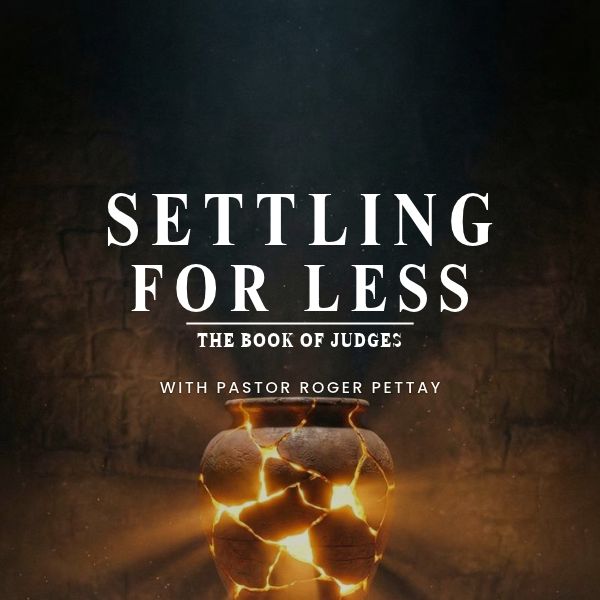
What the Book of Judges teaches us about compromise, obedience, and the danger of stopping short.
Have you ever started something with great enthusiasm, only to stop before finishing? Maybe it was a home improvement project, a commitment to exercise, or a personal goal that seemed important at the time. You made progress, but somewhere along the way, you became comfortable with how far you had come and decided that was good enough.
Unfortunately, we can approach our relationship with God the same way.
We begin with enthusiasm, determined to follow Christ and obey His Word. But over time, we become comfortable. We make excuses for certain habits, tolerate attitudes we know are wrong, and convince ourselves that partial obedience is sufficient.
This is precisely what happened to the Israelites in the opening chapter of the Book of Judges.
#1: GOD’S PROMISES REQUIRE OUR TRUST
The Book of Judges begins at a significant turning point in Israel’s history. Moses had died, Joshua had led the people into the Promised Land, and now Joshua was gone as well.
For the first time in generations, Israel found itself without a strong national leader.
Judges 1:1–2 (ESV) tells us: “After the death of Joshua, the people of Israel inquired of the LORD, ‘Who shall go up first for us against the Canaanites, to fight against them?’ The LORD said, ‘Judah shall go up; behold, I have given the land into his hand.”
Notice God’s words: “I have given the land into his hand.” God wasn’t suggesting that victory might be possible. He was declaring what He had already determined to accomplish.
The Israelites still had battles to fight, enemies to confront, and territory to possess. But they were supposed to approach those challenges with confidence in God’s promise.
The same principle applies to us. God has not promised Christians a trouble-free life, but He has given us tremendous promises in Christ. We are called to trust Him even when obedience requires courage, sacrifice, or perseverance.
Faith doesn’t mean the absence of obstacles. Faith means trusting God in the presence of obstacles.
#2: SMALL COMPROMISES CAN LEAD TO BIG CONSEQUENCES
As Judges 1 unfolds, we discover a troubling pattern.
Initially, the Israelites experienced military victories. Cities were conquered, enemies were defeated, and territory was secured. Everything appeared to be moving in the right direction.
But then something changed.
Rather than completing the conquest as God had commanded, the tribes began allowing the Canaanites to remain in the land.
Judges 1:28 (ESV) says: “When Israel grew strong, they put the Canaanites to forced labor, but did not drive them out completely.”
This is particularly revealing. Israel had become strong enough to control these people, but instead of obeying God’s command, they chose an arrangement that benefited them economically.
What may have seemed like a practical decision was actually disobedience.
And it didn’t happen in just one tribe. Throughout the chapter, the same pattern repeats. One tribe after another failed to drive out the inhabitants of the land.
Their incomplete obedience would eventually create enormous spiritual problems. The surrounding nations and their false gods would become a continuing source of temptation, drawing Israel away from the Lord.
Compromise rarely announces itself as rebellion. More often, it disguises itself as convenience, practicality, or necessity.
We tell ourselves that a particular habit isn’t really hurting anyone. We excuse bitterness because someone mistreated us. We justify dishonesty because telling the truth might cost us something. We tolerate attitudes and behaviors that God’s Word clearly calls us to confront.
Over time, what we once resisted becomes something we accept.
The danger of compromise is that it gradually changes what we are willing to tolerate.
#3: FEAR CAN KEEP US FROM OBEYING GOD
One of the most revealing statements in Judges 1 appears in verse 19: “And the LORD was with Judah, and he took possession of the hill country, but he could not drive out the inhabitants of the plain because they had chariots of iron.” (ESV)
Chariots of iron represented a significant military advantage in the ancient world. To an army fighting primarily on foot, they were intimidating weapons.
But consider the contradiction.
The verse begins by telling us that the Lord was with Judah. Yet it ends by describing an enemy they could not drive out because of its superior military equipment.
They were looking at the strength of their enemy rather than trusting the strength of their God.
Does that sound familiar? Years earlier, Moses had sent twelve spies into the Promised Land. Ten returned terrified because they had seen giants and fortified cities. Only Joshua and Caleb believed God could give them victory.
All twelve spies saw the same obstacles. The difference was how they interpreted what they saw.
Ten measured their circumstances against their own abilities. Joshua and Caleb measured their circumstances against God’s promises.
We face similar choices today.
Sometimes we avoid difficult conversations because we fear rejection. We hesitate to obey Scripture because we worry about the consequences. We resist making necessary changes because the obstacles seem overwhelming.
Fear can become a powerful excuse for disobedience.
But the question isn’t whether the challenge is greater than our strength. The question is whether we trust the God who has called us to obey Him.
#4: WHAT WE ALLOW TO REMAIN CAN EVENTUALLY CONTROL US
One of the most sobering developments in Judges 1 is how the balance of power begins to change.
At first, Israel was conquering territory and defeating enemies. Then the Israelites began allowing their enemies to remain. Eventually, some of those enemies gained the upper hand.
Judges 1:34 (ESV) says “The Amorites pressed the people of Dan back into the hill country, for they did not allow them to come down to the plain.”
Think about that.
The people who were supposed to possess the land were now being pushed back by the very inhabitants they had failed to remove.
What Israel tolerated eventually became something that restricted them.
There is an important spiritual lesson here.
Sin is never as harmless as it initially appears. What begins as a small compromise can develop into a destructive pattern. An attitude we refuse to confront can eventually shape our character. A habit we continually excuse can become increasingly difficult to overcome.
This doesn’t mean Christians will achieve sinless perfection in this life. Scripture teaches that believers continue to struggle against the flesh. But there is a significant difference between struggling against sin and making peace with it.
God calls us to confront sin, confess it, repent of it, and walk in the power of the Holy Spirit. We cannot expect spiritual maturity while deliberately protecting the very things that undermine our obedience.
#5: GOD HAS CALLED US TO MORE THAN SPIRITUAL COMPLACENCY
As we read Judges 1, we are left with a disappointing picture. God had given Israel the land, but the people repeatedly failed to complete what He had commanded.
They experienced victories, but they also settled for incomplete obedience.
The tragedy wasn’t that God had failed to keep His promises. The tragedy was that His people repeatedly failed to trust and obey Him.
That should cause us to examine our own lives.
The Apostle Paul writes in Ephesians 1:3 (ESV): “Blessed be the God and Father of our Lord Jesus Christ, who has blessed us in Christ with every spiritual blessing in the heavenly places.”
In Christ, God has given believers extraordinary spiritual blessings. We have forgiveness, reconciliation with God, the indwelling Holy Spirit, access to the Father, and the promise of eternal life.
Yet how often do we live as though the Christian life consists of little more than attending church, avoiding a few obvious sins, and trying to be reasonably good people?
God calls us to something deeper.
He calls us to grow in holiness, develop spiritual maturity, love others sacrificially, forgive those who have wronged us, serve faithfully, and increasingly reflect the character of Jesus Christ.
None of this earns our salvation. We are saved by grace through faith in Christ, not by our performance. But the grace that saves us also teaches us to turn away from ungodliness and live for Him.
Spiritual growth requires more than good intentions. It involves daily surrender, repentance, faith, and obedience through the power of the Holy Spirit.
We should never become so comfortable with where we are spiritually that we stop pursuing the One who has saved us.
CONCLUSION: WHERE HAVE YOU SETTLED FOR LESS?
The opening chapter of Judges is more than an account of ancient military campaigns. It is a warning about the consequences of compromise and the danger of incomplete obedience.
Israel’s greatest problem wasn’t the strength of the Canaanites or the sophistication of their iron chariots. It was the people’s recurring failure to fully trust and obey the Lord.
Perhaps the most important question we can ask ourselves is this:
Where have I settled for less than what God has called me to be?
Is there a sinful habit you continue to excuse? A relationship where you refuse to forgive? A difficult act of obedience you have been postponing? An area of your life where fear has become more influential than faith?
Whatever it may be, don’t make peace with what God is calling you to confront.
The good news is that our hope doesn’t rest in our ability to obey perfectly. It rests in Jesus Christ, who obeyed the Father perfectly, died for our sins, and rose again. Through Him, we receive both forgiveness for our failures and the grace to walk in the newness of life.
Don’t confuse progress with completion. Don’t allow yesterday’s victories to become an excuse for today’s complacency.
God has called us to walk by faith, live by the Spirit, and continue growing in obedience to Him.
Don’t settle for less.
Bible References:Judges 1:1–2 (ESV); Judges 1:19 (ESV); Judges 1:28 (ESV); Judges 1:34 (ESV); Ephesians 1:3 (ESV)
Watch & Listen to the Full Message
Watch on YouTube: Pastor Roger’s full message
Listen to the Podcast: Pastor Roger’s full message
#BookOfJudges #SettlingForLess #ChristianLiving #Judges1 #PastorRogerPettay #ExaltChurch #BibleTeaching #SpiritualGrowth #FaithAndObedience #TrustGod #ChristianSermon #BiblicalTruth